
Marine Anchor,Boat Bollard,Thru-Hull,Boat Cleat,Boat Seat,R&D Customized Marine Products,Seawater Strainers,Pull Rings,Marine Steering Wheel,Deck Filler,Pipe Stanchion,Hinge,BIMINI Fitting,Bow Chock,Boat Anchor Roller,Marine Ladder,Fishing Rod Holder,Deck Plate,Antenna Base,Cockpit Drain,Turning Lock,OEM/ODM Marine Hardware,Chain Stopper,Anchor Connector,Tank Vent,Boat Anchor,Copper Plated Marine Hardware,Brass Bronze Parts,Anchor Chain


When a handrail system has to change direction or split into a branch, the fitting you choose decides whether the installation feels rock-solid or becomes a constant source of movement and corrosion. The 316 Stainless Steel 90 Degree Handrail Tee from Shandong Power Industry and Trade Co., Ltd. is built for exactly that moment. It connects three sections of tubing at a clean right angle, giving you a strong T-junction that holds its alignment in marine air, poolside humidity, industrial washdown areas, and outdoor architectural railings.
This tee is not a thin decorative cover. It is a load-bearing connector machined from genuine 316 stainless steel, the grade commonly specified for saltwater and chemical exposure. The wall thickness, the deep socket, and the polished surface all work together to provide a secure mechanical grip once the tube is inserted and set with adhesive or a set screw, depending on the installation method you prefer.
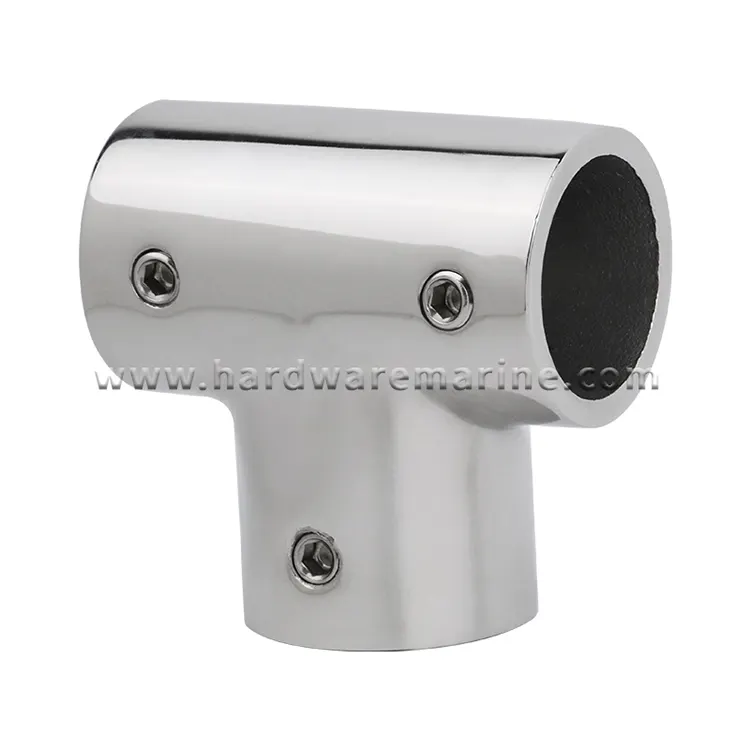 316 Stainless Steel 90 Degree Handrail Tee main view" style="max-width:100%;height:auto;margin:16px 0;" />
A 90 degree tee is used wherever a handrail must split from a main run. On a boat deck, that might mean a side rail that meets a gate upright. On a commercial staircase, it may be the point where a guardrail meets a mid-rail. Around a swimming pool, it can connect a horizontal rail to a vertical support at the corner of a ladder cage or a child-safety gate. In each case, the tee has to handle three axes of force: downward weight, lateral push, and vibration from foot traffic or wave motion. A poorly made tee will loosen at the joint, allow water inside, and eventually stain the surrounding tube.
The 316 Stainless Steel 90 Degree Handrail Tee solves this by providing a full-depth socket on all three openings. Each tube end seats fully into the fitting, which distributes stress evenly and reduces the chance of a wobbly connection. Because the material itself is 316 stainless steel, the fitting expands and contracts at the same rate as 316 or 304 tubing, preventing the micro-gaps that lead to crevice corrosion.

The biggest difference between ordinary handrail fittings and this tee comes down to molybdenum. Type 316 stainless steel contains molybdenum, which significantly improves resistance to chlorides. Chlorides are present in seawater, de-icing salts, and many cleaning chemicals. A fitting made from 304 stainless steel may look identical on day one, but after months of salt spray it often develops brown tea stains or small pits at the joint. Type 316 resists that attack far longer, which is why it is the preferred material for marine hardware and coastal buildings.
Shandong Power Industry and Trade Co., Ltd. sources raw 316 stainless steel for this tee, then precision-casts or forges the body depending on the diameter. The result is a fitting with a dense, non-porous surface that does not trap moisture. The grain structure is uniform, so polishing reveals a bright, reflective finish that resists fingerprints and wipes clean with a damp cloth.
For builders who work near saltwater, this is not a small detail. Replacing a corroded fitting on a 20-meter yacht railing means cutting out old tubing, cleaning the joint, and re-polishing the surrounding area. The labor usually costs far more than the fitting itself. Choosing 316 from the start reduces that lifecycle cost dramatically.
The tee is named for its 90 degree geometry, and that angle must be precise. If the tee is even one degree off, the entire railing run will twist, the tube ends will bind, and the installer will have to force the assembly into place under tension. That tension can crack adhesive bonds or cause the fitting to creep over time. This tee is produced with controlled tooling to hold the right-angle tolerance across all production batches. As a result, three lengths of tube mate with the tee squarely, and the assembled railing looks intentional rather than improvised.
The sockets are designed to accept standard handrail tubing diameters. Common sizes include 25 mm, 32 mm, 38 mm, 42.4 mm, and 48.3 mm outer diameter tube. The tee is available in matching sizes, so you can order the same fitting for your entire railing system without mixing suppliers. Each socket depth is calibrated to provide enough engagement for structural strength while leaving room for adhesive flow or set screw positioning.

Many railing failures start with a fitting that looks good in a catalog but fails after the first season. The casting may have hidden porosity, the wall thickness may be thinner than advertised, or the polishing compound may hide rough areas that later collect salt. In a marine environment, those flaws turn into red rust streaks running down the tubing.
This tee from Shandong Power Industry and Trade Co., Ltd. is manufactured under a quality control process that checks wall thickness, socket diameter, surface finish, and angle at multiple stages. The factory performs dimensional inspection on each batch, not just random samples. That consistency matters when you are installing fifty identical tees along a balcony railing and every joint must line up without adjustment.
Another common issue is internal roughness. A cast fitting may have burrs or sharp edges inside the socket that scratch the tube during insertion, removing the protective oxide layer. This tee is deburred and polished to a smooth finish inside and out, reducing the risk of creating corrosion initiation points during assembly.
The standard finish for this tee is a mirror polish on the visible surface. That bright finish complements high-end interior railings, boat deck hardware, and architectural stainless steel systems. A satin or brushed finish is available for projects where a softer, more contemporary look is desired. Both finishes are created by mechanical polishing, not by a temporary coating, so the appearance lasts as long as the material itself.
Because 316 stainless steel is non-magnetic and has a neutral silver tone, the tee blends with most stainless steel tube, glass clamp systems, and cable railing components. You can use it in a residential stair railing without it drawing attention, or in a commercial marine application where the bright surface adds a professional finished look.

The following scenarios show where the 316 Stainless Steel 90 Degree Handrail Tee provides a direct solution to a known problem.
Pain point: The original railing used 304 fittings. Within eight months, brown stains appeared at every T-joint where salt mist collected. The owner wanted a repair that would not require annual scrubbing.
Solution: Replace the corroded T-joints with this 316 stainless steel tee. The molybdenum content in 316 resists chloride attack, and the smooth polished surface sheds water quickly. After installation, the railing remains bright with only occasional washing.
Pain point: The handrail needed to split from the side rail to a boarding gate, but the original tee was too loose and the gate rattled under engine vibration.
Solution: This tee provides a deep, tight socket engagement on all three tube ends. Once the tubes are seated and secured, the connection stays rigid, eliminating the rattle and improving safety for passengers boarding at the dock.
Pain point: The pool safety gate had a welded T-joint that cracked at the weld toe after repeated slamming. A weld repair would require grinding and repolishing, and the heat-affected zone would be more prone to corrosion in chlorine vapor.
Solution: Use this tee instead of a welded joint. The mechanical connection absorbs impact without concentrating stress at a weld line. If the gate ever needs adjustment, the tee allows disassembly and reuse, which a welded joint does not.
| Parameter | Typical Value |
|---|---|
| Material | 316 stainless steel / marine grade |
| Fitting type | 90 degree tee / T-joint |
| Compatible tube OD | 25 mm, 32 mm, 38 mm, 42.4 mm, 48.3 mm |
| Angle tolerance | ±0.5 degree |
| Surface finish | Mirror polished or satin brushed |
| Socket depth | Full-depth engagement for structural seating |
| Wall thickness | Matches standard schedule tube wall |
| Weight | Varies by diameter, approximately 0.15–0.45 kg |
| Packaging | Individual poly bag, then master carton |
| Certification | Material mill certificate available on request |
| Applications | Marine railing, pool fencing, stair handrail, guardrail, architectural tubing |

Anyone who builds, repairs, or restores stainless steel railing systems can benefit from this fitting. Marine engineers and boat fitters use it for deck rails, boarding gates, and grab rails on yachts, sailboats, and pontoon boats. Swimming pool contractors select it for ladder cages, handrails, and safety fences where chlorine and humidity are constant. Architectural metalworkers install it in staircases, balconies, and accessible ramps where a polished stainless steel railing must match a modern interior. Facilities managers use it to repair damaged railings in coastal hotels, water parks, and wastewater treatment plants.
For DIY boat owners, the tee offers a practical repair part that can be installed without welding. If an old welded joint fails, you can cut out the damaged section, deburr the tube ends, and insert them into the tee with a marine-grade adhesive or drill for a set screw. The repair can be completed in an afternoon with basic hand tools.
A railing is something people touch every day. When the joints are tight and the surfaces are smooth, the whole structure feels solid. That feeling matters on a boat where passengers grab the rail for balance, on a staircase where an elderly person leans on the handrail, or at a pool where children hold the bar while climbing out. A loose tee turns a safety feature into a source of anxiety. A well-made tee restores confidence.
The visual change is just as important. A polished 316 tee reflects light cleanly and matches the surrounding tube, so the railing looks professionally finished. There are no weld spatter marks, no discolored heat zones, and no rust streaks running from the joint. The owner can focus on enjoying the space instead of constantly touching up stains.

The market is full of stainless steel handrail fittings, but not all of them are equal. The key differences with this tee start with the material. Many low-cost tees are made from 304 or even lower-grade stainless, then marketed as marine hardware. They may work for interior railings, but they will not survive long in salt air. This tee is verifiably 316 stainless steel, and Shandong Power Industry and Trade Co., Ltd. provides material documentation to support that claim.
The second difference is the socket design. Some tees have shallow sockets that only grip the last few millimeters of tube. This tee uses a deeper socket profile that increases the bonded or screwed engagement length. The result is a stronger mechanical connection that resists pull-out, twist, and vibration.
The third difference is surface quality. Instead of a rough casting that has been quickly polished on the outside, this tee is finished to a uniform smoothness on all visible and internal surfaces. That reduces water retention, makes cleaning easier, and gives the installed railing a high-end appearance.
The fourth difference is consistency. Shandong Power Industry and Trade Co., Ltd. produces these tees in controlled batch sizes with regular inspection of dimensions, angle, and finish. When you order for a project that requires twenty or one hundred tees, you can expect the same fit and appearance across the entire shipment.

Installing the tee is straightforward. Measure and cut the tube ends square using a tube cutter or fine-tooth saw. Deburr the inside and outside edges to prevent scratching the socket. Clean the tube ends and the inside of the tee with a solvent that removes oils and loose particles. For a permanent connection, apply a marine-grade structural adhesive designed for stainless steel, then insert the tube fully into each socket. Wipe away excess adhesive before it cures. For a removable connection, you can drill a small pilot hole through the tee wall and install a stainless steel set screw or blind rivet, but be sure to use a 316 fastener to avoid galvanic mismatch.
Maintenance is minimal. Wash the fitting with mild soap and fresh water, especially after exposure to salt or chlorinated water. Avoid abrasive pads that contain iron particles, because those particles can embed in the surface and cause rust spots. A soft cloth and stainless steel cleaner are sufficient for restoring shine. If the fitting is used in a harsh chemical environment, rinse it regularly to prevent chloride buildup in crevices.

What exactly is a 90 degree handrail tee used for?
It is a T-shaped connector that joins three sections of round handrail tube at right angles. The main run passes straight through the tee, while the third socket branches off at 90 degrees. This allows a handrail to split from a straight run to a gate, a vertical support, or another railing section without welding or bending the tube.
Can this tee be used in a saltwater environment?
Yes. The tee is made from 316 stainless steel, which contains molybdenum for improved resistance to chlorides found in seawater and salt spray. It is suitable for boat decks, docks, coastal balconies, and other marine or high-salinity locations. Regular rinsing with fresh water will further extend its service life.
What tube sizes does this tee fit?
The tee is available for common handrail tube outer diameters, including 25 mm, 32 mm, 38 mm, 42.4 mm, and 48.3 mm. You should measure the outside diameter of your existing tube before ordering. If your tube size is not listed, contact the supplier to ask about custom sizing or adapter availability.
Do I need to weld the tubes into the tee?
No. The tee is designed for mechanical connection. You can use a high-strength marine adhesive for a clean, permanent bond, or you can secure the tube ends with 316 stainless steel set screws if you need to disassemble the railing later. Welding is possible but not required, and avoiding welding preserves the polished finish and reduces heat-affected zone corrosion risk.
How does 316 stainless steel compare to 304 stainless steel?
Both are austenitic stainless steels, but 316 contains molybdenum while 304 does not. The molybdenum gives 316 significantly better resistance to pitting and crevice corrosion in chloride-rich environments. For interior railings, 304 may be sufficient, but for marine, coastal, pool, or industrial uses, 316 is the safer and longer-lasting choice.
Is the finish bright enough for a high-end interior railing?
Yes. The mirror polished version of this tee has a bright, reflective surface that matches polished stainless steel tube and complements modern architectural designs. If a softer look is preferred, a satin brushed finish can be specified. Both finishes are mechanical polishes, not paint or coating, so they will not peel or fade.
Can I reuse the tee if I need to modify the railing?
In most cases, yes. If the tube was secured with set screws, you can loosen the screws, remove the tubes, and reuse the tee in a new configuration. If adhesive was used, the tee is more difficult to remove, but it can often be cut free and re-polished if necessary. The solid 316 construction holds up well to careful disassembly and reassembly.
How is the tee packaged for shipping?
Each tee is individually wrapped in a poly bag to protect the polished surface during transit. Multiple tees are then packed into a master carton with internal dividers to prevent scratching. Bulk packaging options are available for large projects. Shandong Power Industry and Trade Co., Ltd. can provide customized packaging labels if required.
Is this tee suitable for a swimming pool safety fence?
Yes. The 316 stainless steel material resists chlorine and high humidity, and the smooth polished surface is easy to clean. The tee provides a strong, non-welded junction for pool fence gates and uprights, which is important because pool safety barriers are subject to repeated impact and must remain rigid.

A handrail system is only as reliable as its weakest connector. When the connection point is a 90 degree branch, the tee takes the most stress and the most exposure. By choosing the 316 Stainless Steel 90 Degree Handrail Tee from Shandong Power Industry and Trade Co., Ltd., you are putting a marine-grade, dimensionally precise, beautifully finished fitting at that critical point. The result is a railing that stays tight, clean, and safe through seasons of salt, sun, water, and heavy use.


