Marine Anchor,Boat Bollard,Thru-Hull,Boat Cleat,Boat Seat,R&D Customized Marine Products,Seawater Strainers,Pull Rings,Marine Steering Wheel,Deck Filler,Pipe Stanchion,Hinge,BIMINI Fitting,Bow Chock,Boat Anchor Roller,Marine Ladder,Fishing Rod Holder,Deck Plate,Antenna Base,Cockpit Drain,Turning Lock,OEM/ODM Marine Hardware,Chain Stopper,Anchor Connector,Tank Vent,Boat Anchor,Copper Plated Marine Hardware,Brass Bronze Parts,Anchor Chain


The moment you step onto the dock, your vessel becomes an extension of your intention. Every line you tie, every cleat you trust, tells a story of preparation, confidence, and respect for the sea. Yet too many boat owners discover, often at the worst possible time, that their mooring hardware isn't telling the same story. A pitted bollard, a frozen pin, a surface rust stain running down the deck—these aren't just cosmetic disappointments. They are warnings. Warnings that the equipment designed to keep your investment safe has already started to fail against salt, wind, and tide. That's why we believe in bringing you something genuinely enduring, something forged from knowledge of what the ocean demands.
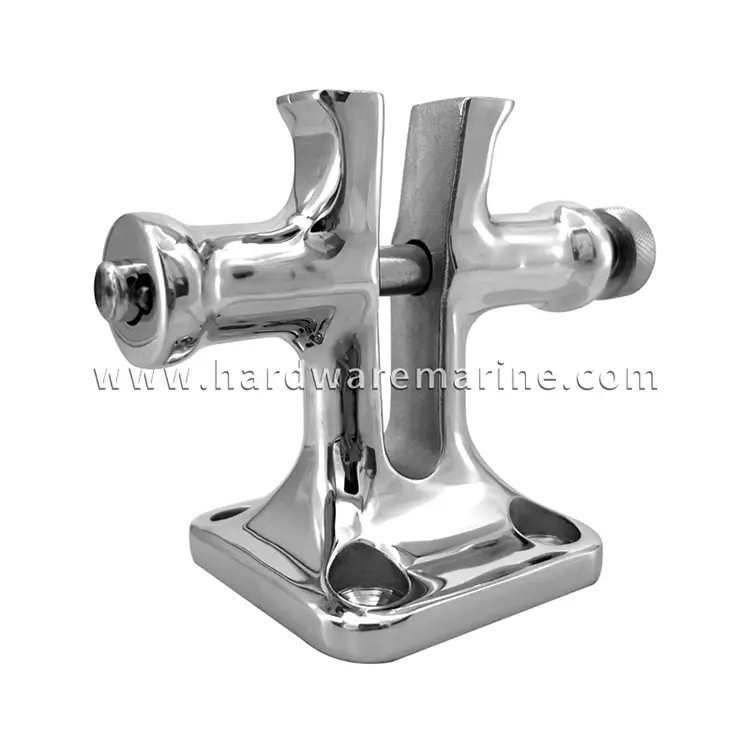
 316 Stainless Steel Marine Split Bollard With Pin close-up detail showcasing mirror-polished surface and precision-crafted pin mechanism">
At Shandong Power Industry and Trade Co., Ltd., we have spent years listening to captains, dockmasters, and marine engineers. They describe a recurring frustration: bollards that look robust on the spec sheet but fail to withstand continuous exposure to a marine environment. They talk about the corrosion that starts inside the casting, the seized pins that turn an emergency release into a struggle, and the polished finishes that dull within a season. These conversations shaped every angle, every alloy choice, and every quality check behind our solution. The 316 Stainless Steel Marine Split Bollard With Pin was designed not simply as another dock fitting, but as a commitment to predictable, season-after-season dependability. It addresses those precise pain points—unseen internal corrosion, mechanism failure under load, and the slow erosion of performance that ordinary stainless steel cannot prevent.
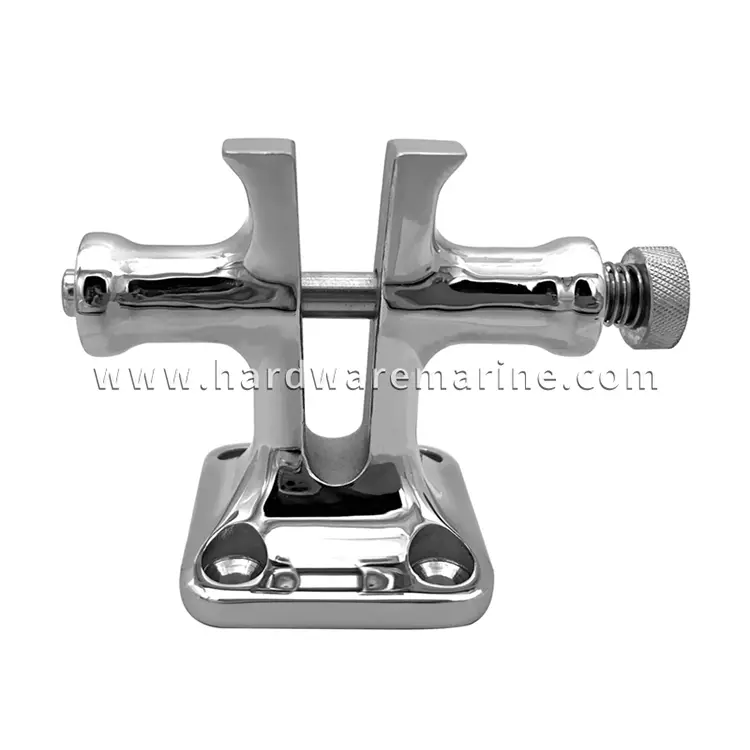
Imagine approaching a familiar berth in a sudden squall. The wind is pressing your hull off the dock, the fenders are groaning, and your crew needs to make fast a spring line in seconds, not minutes. In that moment, the shape of your bollard, the reliability of its locking pin, and the integrity of its anchor points become the only things standing between a controlled docking and a costly impact. Our split bollard design recognizes this urgency. The removable pin, machined to a tolerance that resists binding even after months of salt spray, allows you to thread a spliced eye or a heavy-duty mooring line over the post in a single fluid motion. There's no awkward threading, no need to feed the entire length of a line through a closed ring. The split post opens the working area, making it intuitive for both seasoned sailors and novices who need to react fast.
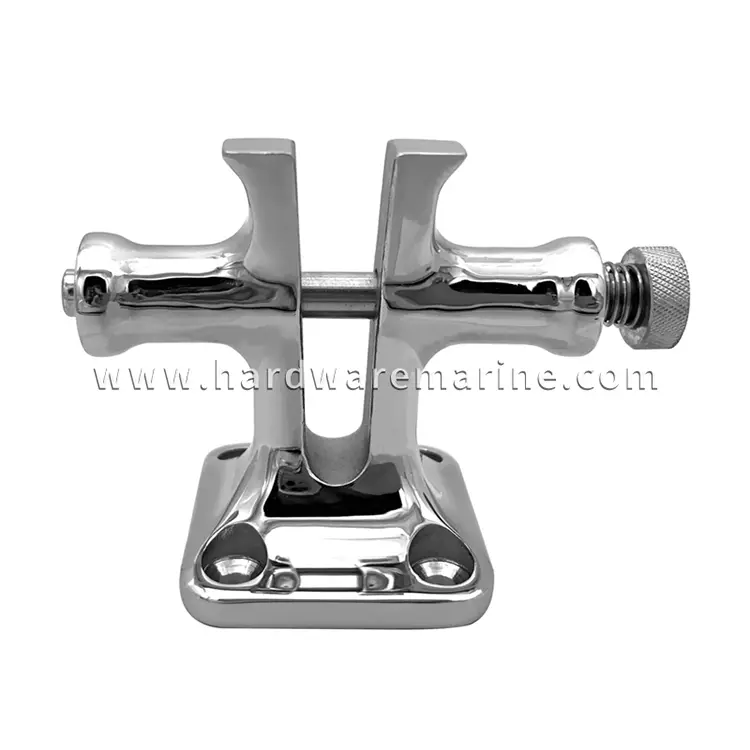
The heart of this product's endurance lies in its material integrity, something we don't treat as a marketing bullet point but as an engineering prerequisite. While many marine fittings use 304 stainless steel, which offers moderate corrosion resistance, 316 stainless steel introduces molybdenum into the alloy. This addition creates a material that actively resists pitting and crevice corrosion caused by chlorides—the ever-present salt in seawater and sea air. Pitting is insidious; it begins microscopically, often in the tiny crevices between the bollard stem and its base, or under the pin. Once started, it accelerates, eventually compromising the structural strength of the fitting. A bollard that looks solid on the outside might be hollowing out internally where moisture accumulates. By specifying 316 stainless steel, we eliminate the material vulnerability that triggers this chain of failure. Every portion of the 316 Stainless Steel Marine Split Bollard With Pin, from its thick-walled stem to its precisely turned pin, benefits from this enhanced alloy chemistry. The result is a uniform resistance to the salt-laden atmosphere, whether your vessel is moored in a tropical marina, subjected to high-humidity fog banks, or exposed to industrial coastal pollutants.
Beyond the base material, our manufacturing process amplifies the innate strengths of 316 stainless steel. The bollard is not simply machined and polished; it undergoes a passivation treatment that removes free iron from the surface, further enhancing the natural formation of the chromium oxide layer that gives stainless steel its stain-fighting character. This means the mirror-like finish you see upon unboxing isn't just for aesthetic appeal. It's a functional layer, smoother and more homogenous than a raw machined surface, providing fewer nucleation points for salt crystals to stick and begin their corrosive work. Over time, this finish will resist the gradual fogging and discoloration that plagues lesser grades. When you run your hand over the bollard, you'll feel a cool, uninterrupted surface that speaks of precision casting and careful polishing. There are no sharp mold lines or rough investment casting remnants where a line could chafe or where moisture could pool. Every edge that could cut a dock line has been hand-finished, preserving both your ropes and the confidence of your crew.
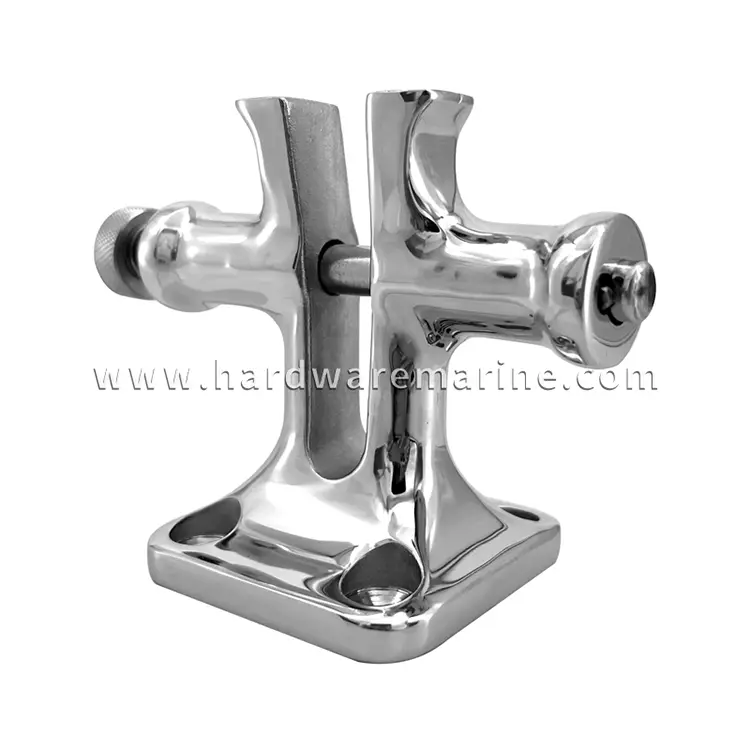
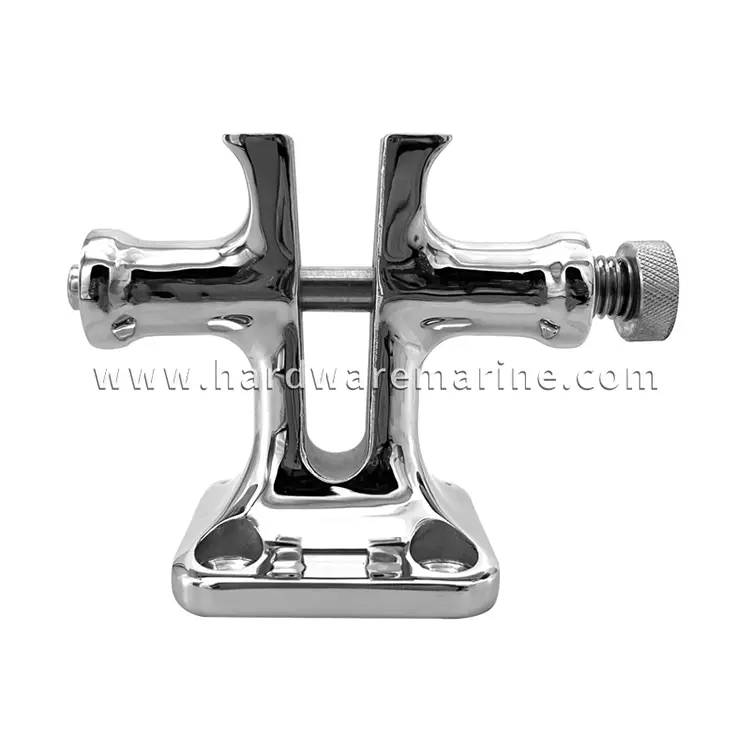
The split design itself is a study in mechanical simplicity married to robust function. The central post forms the load-bearing core, spreading mooring forces down through a wide mounting flange. The pin, seated in a close-tolerance bore, acts as both a retainer and as a secondary attachment point. Because it is fully removable, you gain incredible versatility. You can use the post alone for rapid, temporary line drops, or you can insert the pin above a spliced loop to create a completely enclosed belay point that cannot accidentally jump free, regardless of tide-driven changes in line angle. This dual-mode capability directly addresses the conflict between speed of use and security of attachment. A traditional closed-top cleat or bollard forces you into a compromise: either tie a knot that may jam, or leave a loop that could lift off under slack conditions. With the pin in place, a spliced eye is locked as securely as if it were captured by a welded ring, yet releasing it requires only pulling the pin—no need to undo a stubborn knot with wet, cold fingers.
Shandong Power Industry and Trade Co., Ltd. built this bollard to thrive in the kinds of environments where failures cascade. Consider a sailboat moored in a tidal estuary. The water level changes by several feet, causing the mooring lines to alternately tension and slacken. As the line pulls taut, it transfers a lateral load to the bollard's base and a twisting moment to the post. As it slackens, the pin sees a completely different vector of force, often a jarring motion when the line snatches tight again on the next swell. This cyclical loading can fatigue a poorly designed casting, initiating hairline cracks at the base radius where stress concentrates. We've countered this by designing generous fillets—curved transitions where the post meets the flange—that distribute stress evenly rather than focusing it on a sharp corner. The result is predictable fatigue life, even under the continuous low-frequency cycling that defines a moored vessel's existence. The pin itself, often the overlooked weak point, is manufactured from the same 316 stainless bar stock, not a cheaper plated steel. A plated pin will have its coating compromised the first time it's inserted or removed under load, exposing the carbon steel beneath and guaranteeing rust within weeks. Our pin remains dimensionally stable and corrosion-free, matching the lifespan of the bollard body.
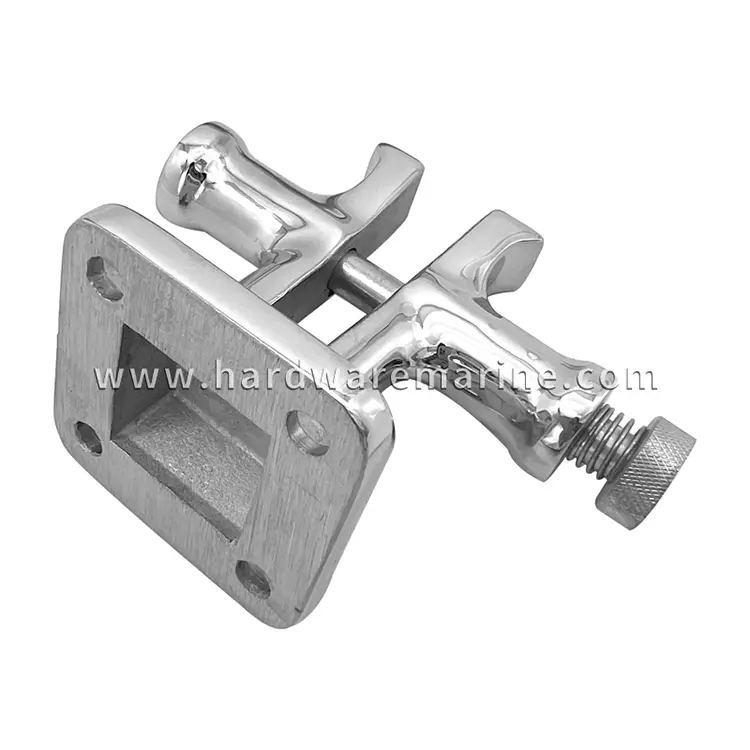
Installation brings its own set of challenges, and the best hardware is designed to make that process fast and foolproof. The base flange of this split bollard features countersunk mounting holes arranged on a symmetrical pattern. This symmetry prevents the mistake of orienting the fitting incorrectly relative to expected load direction; no matter how the installer rotates it before drilling, the load distribution remains optimal across all four fastener positions. The underside of the flange is milled flat to seat securely against deck timber, fiberglass, or a metal backing plate, eliminating the wobble that can translate into deck gelcoat cracking. We recommend pairing the bollard with a substantial backing plate of marine-grade aluminum or stainless steel to further distribute the load into the hull structure, but the flange geometry itself already sets a strong foundation. Every unit ships with a comprehensive specification card that includes bolt hole diameters, recommended torque values, and bedding compound suggestions, turning what could be a confusing custom installation into a straightforward task for any yard or a confident DIY owner.
| Parameter | Specification |
|---|---|
| Material | Grade 316 stainless steel (body, pin, and base) |
| Surface finish | High-polish mirror with passivation treatment |
| Overall height | 180 mm (7.09 inches) |
| Post diameter | 32 mm (1.26 inches) |
| Base flange dimensions | 130 mm × 130 mm (5.12 × 5.12 inches) |
| Base thickness | 10 mm (0.39 inches) |
| Pin diameter | 14 mm (0.55 inches) |
| Mounting holes | 4 × 10.5 mm (0.41 inches) counterbored |
| Maximum static load | 4,500 kg (9,920 lbs) with appropriate backing plate |
| Weight | 3.2 kg (7.05 lbs) |
| Pin retention | Friction-fit with optional lanyard attachment point |
The numbers tell a clear story of capability, but they only hint at the human experience behind them. When you kneel on a gently rocking deck and press the pin home until it clicks into place, the action feels decisive. You know, without looking again, that the line won't ride up, won't snag, won't betray you in the middle of a moonless night when the wind shifts and the load peaks. That feeling—of buttoning up your vessel securely—translates directly into better sleep aboard and less anxiety ashore. For live-aboard cruisers, a bollard is more than a chunk of metal; it's a psychological boundary between the controlled environment of the boat and the unpredictable nature outside. The 316 Stainless Steel Marine Split Bollard With Pin reinforces that boundary with unshakeable solidity.
Who truly needs this level of hardware? The answer reaches far beyond a single type of boater. A commercial fishing boat operator, returning to port after days of hauling gear, needs to tie up rapidly without fumbling with corroded cleats. A yacht captain preparing for a transatlantic crossing wants to snake multiple redundant dock lines to a single secure point without creating a tangled mess. A marina manager replacing aging infrastructure seeks a uniform standard that will keep slips safe and reduce liability for decades. Even the weekend center-console angler, who might think his needs are modest, reaps the benefit when he catches a sudden summer storm and must dodge a lee shore. In each scenario, the common thread is a demand for absolute reliability in a hostile environment, paired with an operational efficiency that saves time and reduces crew fatigue.
Our company, Shandong Power Industry and Trade Co., Ltd., does not view itself as merely a distributor of off-the-shelf marine components. We are a collaborative partner to shipyards, port authorities, and aftermarket suppliers. Every 316 Stainless Steel Marine Split Bollard With Pin that leaves our facility undergoes a multi-step inspection protocol that includes dimensional verification against CAD master models, surface roughness testing, and a salt spray exposure check on sample lots to confirm that the passive layer performs to specification. This isn't a theoretical exercise; we maintain a documented quality control dossier that we're happy to share with bulk purchasers or regulatory bodies. Our facility operates under an ISO 9001-certified management system, ensuring that process repeatability is as critical as the final product appearance. When you order from us, you aren't purchasing a commodity; you're tapping into a supply chain that values traceability, ethical sourcing of stainless steel stock, and a commitment to zero-defect delivery.
Let's address the comparison that inevitably arises: why choose a split bollard with a pin over a traditional cast closed bollard or a standard cleat? Closed bollards, while historically common, present a significant limitation in line handling. To attach a fixed-eye mooring line, you must feed the entire free end of the line through the opening, a process that can be nearly impossible if the other end is already made fast to a cleat on the boat. In an emergency, that wasted time could mean the difference between a controlled recovery and a collision. A standard cleat, while quick to use, doesn't provide a positive lock against a loop jumping off; it relies entirely on the friction of the figure-eight pattern and the downward angle of the line. When a boat surges on a long dock line, the momentary slack can allow a cleat hitch to slip. The 316 Stainless Steel Marine Split Bollard With Pin eliminates both compromises. The removal of the pin gives you the open-top access of a bollard, while reinserting the pin delivers the positive capture of a closed ring. This dual-function design means you don't need separate deck fittings for quick temporary ties and permanent security; one fitting does both, reducing deck clutter, weight, and the number of penetration holes in your deck core.
Maintenance is another area where this product distinguishes itself from the competition. Many marine fittings demand a sacrificial layer of wax or a monthly wipe-down with corrosion inhibitor to stay presentable. Because we start with true 316 stainless and finish with a mirror polish, routine care for this bollard is remarkably simple. A rinse with fresh water to remove salt crystals, followed by a wipe with a soft cloth, will keep the surface bright for years. Occasional application of a stainless steel polish can remove any tea-staining—a superficial discoloration that may appear in extremely stagnant, oxygen-deprived microenvironments—but such staining remains purely cosmetic and does not affect the structural integrity. There is no painted coating to peel, no zinc plating to sacrifice itself and leave behind a chalky residue, no rubber gasket to dry-rot and let moisture beneath the base. The design's honesty—all metal, all corrosion-resistant, all accessible—means that what you see is exactly what you get, season after season.
For larger vessels or those that operate in high-traffic docking situations, the additional lanyard attachment point integrated into the base flange deserves attention. A small but thoughtful detail, this hole allows you to tether the pin to the bollard body or to the dock itself using a short length of marine-grade dyneema or monofilament. The pin cannot then be accidentally dropped overboard during a hurried line adjustment. On a commercial dock, where a dropped pin might disappear into murky water and require an expensive replacement or cause a slip hazard for the next user, this tethering option pays for itself on the first windy day. It's a feature born from observing how real people work, not from an engineer's idealized calm conditions.
We understand that trust in a product comes not only from its physical attributes, but from the support behind it. Shandong Power Industry and Trade Co., Ltd. provides full pre-sale consultation, including assistance with load calculations for unusual mooring configurations. Our technical team can review your deck layout and advise on the optimal backing plate design for your hull material. Post-sale, we stand behind every bollard with a comprehensive warranty that covers material and manufacturing defects. More importantly, we maintain an inventory depth that allows us to fulfill large orders for new marina construction or fleet retrofits with minimal lead time. This logistical reliability is crucial for projects operating on tight refit schedules.
Let's address some of the most common questions we receive about this product, unpacking the details that help you make an informed choice.
Is the 316 stainless steel used in this bollard truly resistant to all forms of marine corrosion?
While 316 stainless steel provides exceptional resistance to chloride-induced pitting and crevice corrosion, no material is absolutely immune to every corrosive condition. In fully submerged, stagnant, low-oxygen environments, even 316 can be susceptible to crevice corrosion if protective measures aren't taken. However, in the exposed, oxygen-rich application of a bollard above the waterline, our passivated 316 stainless steel will outperform 304 stainless and ordinary chromed brass by a wide margin. The mirror polish further reduces the ability of salt particles to cling to the surface, significantly extending the maintenance-free period. For maximum longevity, we recommend an occasional fresh-water rinse, which will keep the passive chromium oxide layer fully intact for decades.
Can the pin be accidentally pulled out under load, causing the line to release?
The pin is designed with a close-tolerance friction fit that requires intentional force to remove. Under the predominantly downward and lateral loads applied by a mooring line, the pin is actually pressed more firmly into its bore. The geometry of the connection means that tension on the line tends to rotate the pin against the bore wall, increasing the holding friction. To remove the pin, you must deliberately pull it straight upward against this resistance. It will not vibrate loose or work its way out under normal swell conditions. For applications where an extra layer of security is desired, such as unattended long-term moorage, a simple seizing wire through the lanyard hole can positively lock the pin in place, requiring a tool to free it.
Will the mirror polish scratch easily during use?
Stainless steel with a mirror finish will show surface scratches over time, particularly if abrasive dirt or gritty lines are dragged across it. These scratches, however, are purely cosmetic and do not affect the corrosion resistance or structural capacity of the bollard. The high polish is not a coating that can peel; it is the metal itself refined to a smooth state. If the appearance of fine scratches is a concern, they can be removed with a standard stainless steel polishing compound and a soft buffing wheel, restoring the mirror finish. Many owners actually appreciate the subtle patina of light use as evidence of a well-travelled vessel, much like a worn teak deck.
How does the split bollard compare to a standard Samson post in terms of strength?
A traditional Samson post is often a solid forging or a welded structure integrated into the vessel's keel or heavy framing, designed for enormous dynamic loads such as towing. A deck-mounted bollard like ours is intended for mooring and dock line loads, which are significant but typically less than the extreme pulling forces of a tugboat. Our 316 Stainless Steel Marine Split Bollard With Pin is rated for a maximum static load of 4,500 kg when installed with an appropriate backing plate, which is sufficient for vessels up to large cruisers and light commercial craft. For the specific use case of securing to a dock or mooring buoy, this bollard provides all the strength required while offering the handling convenience that a Samson post cannot match. It is not a direct substitute for a heavy towing post, nor is it intended to be.
What type of backing plate do you recommend for through-bolting this bollard?
We recommend a backing plate fabricated from 316 stainless steel or 5086 marine-grade aluminum, with a thickness of at least 6 mm (0.25 inches) and dimensions matching or exceeding the bollard's base flange. The backing plate should be bedded in a high-quality marine sealant to prevent moisture intrusion into the deck core. For installations on cored decks, it is essential to properly pot the bolt holes with thickened epoxy to isolate the core and prevent compression. Our technical team can provide detailed installation drawings upon request, and we always advise consulting a qualified marine engineer when installing high-load deck hardware on a new or unfamiliar hull material.
Can this bollard be used as an anchor point for a safety harness or climbing gear?
No. This bollard is designed exclusively for mooring and docking loads. Safety harnesses, climbing gear, and personnel fall-arrest systems require dedicated, engineered anchor points that meet specific OSHA or relevant international safety standards for shock loading and angle of pull. Using a bollard for such applications is unsafe and can result in catastrophic failure or injury, as the human body generates dynamic forces far different from the static and gradually changing loads of a moored vessel. Please adhere strictly to the manufacturer's designated use case.
When you bring a 316 Stainless Steel Marine Split Bollard With Pin aboard or specify it for a dock, you aren't simply buying a fitting; you're adopting a philosophy of preparedness. That philosophy says that the smallest detail—the alloy content of a pin, the radius of a base fillet, the availability of a tether point—can tip the balance between a seamless docking and a day you'd rather forget. Shandong Power Industry and Trade Co., Ltd. has distilled decades of marine manufacturing experience into this single piece of hardware, and we believe it will redefine your expectations of what a bollard can be. The smooth motion of the pin sliding into place, the satisfying heft when you first pick it up, and the unmatched longevity of its materials combine to create an experience that goes far beyond the transaction. It becomes a trusted, silent partner in every voyage you take.